William Tell and the Swiss people
William Tell (P. G. Wodehouse Edition)William Tell and the Swiss people are joined by a political bond that does not begin with Tell at the head of a conspiracy. The people look to him because he is patriotic and prepared to resist oppression, while Tell distinguishes between leading meetings and taking action. When the decisive struggle comes, his deeds make him a public emblem of resistance; when he is taken away, the people fear they have lost their leader. The relationship’s final measure is collective: the revolt succeeds through popular unity, and Tell’s own account of freedom insists that the people must stand together.
Patriotism Before the Appeal
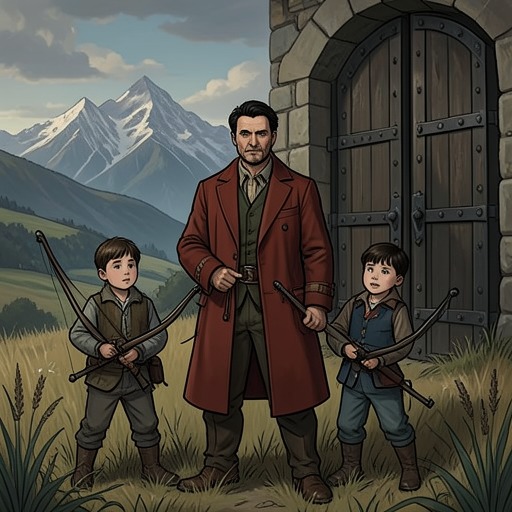
Tell’s connection to the people is rooted in a household already shaped by his expectation of revolt. Although he and his family live contentedly despite Hermann Gessler and his taxes, Tell believes the Swiss will one day rise against the Governor’s tyranny. He drills his two children so they will be prepared, turning their marching, tin-can drumming, and shouts into a domestic rehearsal for a political future. Hedwig objects to the noise and wants the children to help with housework; Tell answers that those who hope to fight through life must be prepared to wield arms. His patriotism is therefore practical as well as declarative: he cultivates readiness at home before the people formally ask for his help.
That preparation also sets a limit on how he understands his own contribution. Tell does not present himself as a strategist or public intellectual. His confidence lies in action, not in directing other people’s plans. The distinction matters to the Swiss people, who need both a figure they can trust and a movement capable of acting together. Tell’s early reluctance to lead a conspiracy does not amount to indifference to the country’s danger; it defines the particular form his commitment will take.
The People Seek a Leader
When the crowd cries out against the taxes, Werner Stauffacher identifies the immediate need: the people want a leader. Arnold of Sewa begins to offer himself for the role, but Werner names Tell as the man suited to it. The crowd answers with cheers and a song of celebration. This nomination makes explicit what Tell’s reputation and patriotism have already suggested: for the people, he represents the possibility of resistance.
The choice carries a serious risk. At the Glass and Glacier, citizens wait anxiously while Werner Stauffacher, Arnold of Melchthal, and Walter Furst go up the steep hill to visit Tell. They understand that a revolution without him would be nearly impossible, but they also know that a failed rising could leave its leader facing execution. When the three spokesmen return without Tell, the crowd suspects that he has refused their offer. His absence on the walk back briefly appears to confirm the people’s greatest fear: that the person on whom they have placed their hopes will not join them.
The spokesmen’s account complicates that first impression. Tell advises patience, reasoning that oppression might lose its force if it fails to provoke a revolt. He also says that he is no use as a plotter or counsellor and does not want to be summoned to meetings merely to speak. Yet he does not abandon the people. He tells them to write if they need him and promises that he will not hang back when there is something to do. The relationship is thus defined by an asymmetry that becomes a strength: the people seek a conventional leader, while Tell offers not to manage their plans but to answer their call in action.
Public Recognition Through Deeds
After the apple shot, the crowd’s response turns Tell’s reputation into public recognition. People cheer him by name, and Ulric the smith declares that no other man in Switzerland could have made the shot. Their acclaim is more than praise for skill: it identifies Tell with a visible act of defiance at a moment when resistance has become public. The people do not merely discuss him as a possible leader; they gather around him as someone whose action has changed what they believe can be done.
Tell, in turn, understands the shot in collective terms. Addressing the crowd, he says that it is the proudest moment of his life and calls the day the first blow of the revolution. He urges the people to strike more blows. His speech briefly makes the relationship reciprocal: the crowd has hailed him, and he answers by presenting the people’s act as the beginning of a shared struggle. The scene also shows how readily their excitement becomes physical. When Tell’s call to strike more blows is misunderstood, some in the crowd attack Friesshardt and Leuthold until Ulric calls for order. Popular enthusiasm is powerful, but it needs direction and restraint as well as a rallying figure.
Arrest, Absence, and Collective Action
The bond is tested when Hermann Gessler’s soldiers tie Tell’s hands. Tell offers no resistance as they lead him to the lake, where Gessler’s ship lies at anchor. The people groan, then tell one another that their last chance is gone and ask where they can look for a leader. Their fear reveals how closely they have attached the fate of the revolt to Tell’s presence. His capture seems, for a moment, to turn a public movement back into a leaderless one.
But the account of the revolt does not leave the people waiting for Tell to return. Gessler’s death signals the rising, which had been brewing for a long time and was supported by a solemn oath to drive the enemy from the country. Nobles and peasants had united, and preparations were already under way throughout Switzerland. When news arrives that the Governor has been slain, people meet in every town and resolve to begin without delay. That same night they take by assault the fortresses Gessler had built. At the last fortress, people who had been forced to help build it pull down the stones themselves, and children join in. The people’s action expands beyond the fate of any one leader: those who had been made to labour for the structures of rule now dismantle them together.
Liberty, Unity, and the Meaning of Leadership
Tell’s response to the fallen regime continues to link his leadership with the people’s shared choices. When some demand that the pole associated with Hermann Gessler be destroyed, Tell stops them and argues that it should remain as a memorial of newly gained liberty. The object is to mark not the perpetuation of submission but the place where, in his formulation, the revolution finished. Arnold of Melchthal questions whether the struggle can truly be considered over while the Emperor of Austria may seek revenge. Tell acknowledges that an attack may come, but answers that the people will meet it together and defend the mountain passes with their bodies. Their great strength, he says, is that they are united.
That insistence on unity also resolves the earlier difference between Tell and the people over what leadership should mean. Tell had rejected a role based on plotting and counsel, not his obligation to the country. The people, meanwhile, prove capable of coordinated action across towns and social ranks, even while Tell is absent. The revolt is neither his solitary achievement nor a movement detached from him: his defiance helps the people imagine resistance, and their collective preparation carries it forward.
The Emperor’s death then allows the revolution to proceed without interruption. His successor is occupied with defending himself against the men who killed his father; by the time he could turn against the Swiss, they are too strong to attack. The account concludes that the Swiss become free. Tell returns home to live happily with his wife and two sons, rather than remaining at the centre of the newly freed country. His relationship with the people ends not in permanent command but in a successful transfer from personal example to collective independence: the people whose need first made him seem indispensable have become strong enough, united, to secure their freedom.